Starting a business is an exciting journey filled with important decisions—one of the first (and most crucial) being how to structure your company. Your business structure affects everything from daily operations to taxes and liability. It’s not a one-size-fits-all situation, so choosing wisely is key.
Here’s a breakdown of the most common business structures, their pros and cons, and how to decide which one is right for your startup.
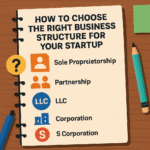
1. Sole Proprietorship
Best for: Solo entrepreneurs testing an idea or launching with minimal risk.
A sole proprietorship is the simplest and most affordable structure. It requires no formal registration beyond necessary licenses and permits.
Pros:
- Easy and inexpensive to set up
- Complete control over the business
- Tax benefits (income is reported on your personal tax return)
Cons:
- Personally liable for all business debts and obligations
- Harder to raise capital
- Limited growth potential
2. Partnership
Best for: Two or more founders who want to share responsibility and profits.
Partnerships come in two flavors: general partnerships (where all partners share responsibility equally) and limited partnerships (where one or more partners are passive investors).
Pros:
- Simple to form and maintain
- Shared financial commitment
- Combined skills and resources
Cons:
- Joint liability (in general partnerships)
- Potential for conflict between partners
- Profits taxed as personal income
3. Limited Liability Company (LLC)
Best for: Startups that want liability protection with flexibility.
An LLC offers a middle ground between a corporation and a sole proprietorship/partnership. It’s one of the most popular choices for small businesses.
Pros:
- Limited liability for owners
- Pass-through taxation (profits taxed on personal returns)
- Fewer formalities than a corporation
Cons:
- Can be more expensive to set up than a sole proprietorship
- Rules vary by state
- Self-employment taxes may apply
4. Corporation (C Corp)
Best for: Startups planning to scale rapidly, seek investors, or go public.
Corporations are separate legal entities owned by shareholders. A C Corporation is the standard structure for large businesses.
Pros:
- Limited liability
- Easier to raise capital through shares
- Credibility with investors and partners
Cons:
- Double taxation (corporate and personal income tax on dividends)
- More regulations and paperwork
- Costlier to establish and maintain
5. S Corporation
Best for: Businesses that want to avoid double taxation but retain corporate benefits.
An S Corp is a special tax designation that allows profits and losses to pass through to shareholders, like an LLC.
Pros:
- Avoids double taxation
- Owners can pay themselves a salary and receive dividends
- Limited liability
Cons:
- Limits on number of shareholders (100 max, U.S. citizens/residents only)
- Stricter IRS scrutiny
- More paperwork than an LLC
So, Which Structure Is Right for You?
Here are a few questions to guide your decision:
- How many people are involved in the business?
- What’s your risk tolerance regarding liability?
- Do you plan to seek outside investment?
- Are you concerned about taxes and compliance complexity?
- What are your long-term growth plans?
Many startups begin as an LLC for simplicity and protection, then convert to a C Corporation when they’re ready to scale or attract venture capital.
Final Thoughts
Choosing the right business structure sets the foundation for your startup’s future. It’s worth taking the time to assess your options—or better yet, consult with a legal or financial advisor to ensure you make the best choice for your goals.
Remember: structures aren’t set in stone. As your startup evolves, your structure can too.